
Geology / Gallery
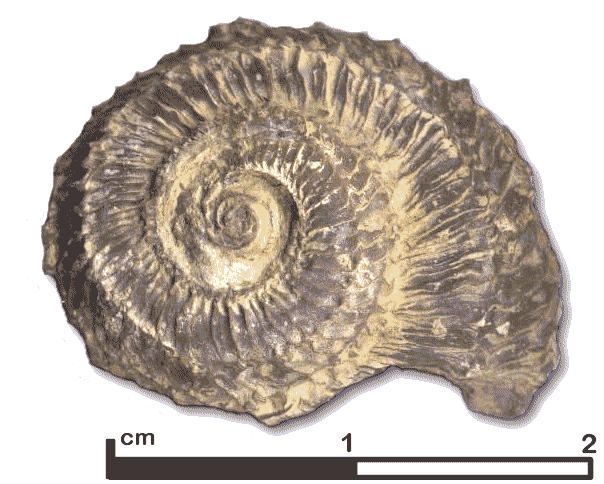
Poleumita discorus (4)
Gastropods are one of the most successful groups of creatures. Present day snails and slugs (marine and freshwater/land) belong to this group. They are probably as numerous today as they have ever been.
They have a more complex structure than other 'shells' such as bivalves including eyes, tentacles and siphons. The class first emerged in the Cambrian ➚, but have limited value in dating rocks as some forms are variable and so difficult to identify with certainty. Other forms persist over very long periods of time. Classification is difficult because the soft parts are very rarely preserved in fossils.
The gastropod Poleumita discors is found fairly readily in the Silurian Wenlock and Ludlow Series, so has its origins firmly rooted in Shropshire, UK.
This example was found in the Wenlock Limestone at Farley Quarry about 3 miles to the North of Much Wenlock.
Specimens of this species can show a surprising range of forms, from flattened to more cone shaped shells, though all have delicate ribbing on their upper side (a common trait in tropical shell fish today) and a smoother underside, for which they have sometimes been mistaken to be Ammonites - a similar looking yet wholly different creature from the Jurassic/Cretaceous periods some 200 million years after Poleumita had begun pushing up the daisies (had there been any daisies at the time).
Several other species of gastropod existed alongside Poleumita during the Silurian, but none so commonly found as this, probably the most attractive of them all.
| Division | Name |
| Phylum | Mollusca |
| Class | Gastropoda |
| Subclass | Prosobranchiata |
| Order | Archaeogasropoda |
This specimen was kindly photographed for us by Merlin
Fossil gallery
- Brittle Star : Lapworthia miltoni
- Trilobite : Dalmanites myops
- Crinoid : Eucalyptocrinites decorus
- Gastropod : Poleumita discorus
- Trilobite : Calymene blumenbachi
- Graptolite : Cyrtograptus murchisoni
- Sponge : Ischadites koenigi
- Conodont : Ozarkodina typica
- Brachiopod : Pentamerus oblongus
- Graptolite : Petalograptus minor
- Brachiopod : Chonetes striatellus
- Cystoid : Lepocrinetes quadrifasciatus
- Bivalve : Pteronitella retroflexa
- Graptolite : Monograptus lobiferus
- Gastropod : Platyceras haliotis
- Crinoid : Sagenocrinites expansus
- Brachiopod : Atrypa reticularis