Life in the Silurian Period
Although life was largely confined to the sea and other areas of permanent wetness (inland lakes and rivers) there was no shortage of life in the Silurian. It was an age before the coming of amphibians, dinosaurs, mammals and birds. So the land and skies were quiet except for the roaring wind. Without much life on land, and the ecosystem that binds the ground surface together, travelling on land would have been unpleasant. Deserts and large river valleys choked with sand and gravel would have been extensive.
Primitive land plants such as Cooksonia ➚ appear in the topmost (youngest) Silurian rocks, so it is likely that the Silurian represents the start of significant life on dry land. In Australia the more complex plant (lycopod) Baragwanathia longifolia ➚ has been found, posing many unanswered questions about the development of land plants. The other main important group to develop rapidly in the Silurian were fish.
Fish were colonizing freshwater rivers and lakes from the sea, ready for the eventual evolution to land based organisms. Fungi are believed to have diversified during the Silurian but these organisms rarely fossilize at all. Blastoids (a type of echinoderm) appeared for the first time. Trilobites and brachiopods were very numerous.
The main divisions of life ➚ of interest to geologists are those giving a wide range of species that quickly become extinct but left easily recognised fossils over as large an area as possible. Graptolites, conodonts and trilobites meet many of these tests.
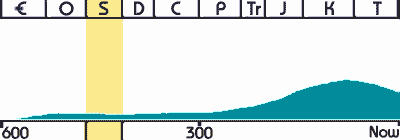
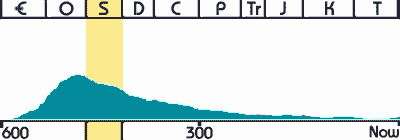
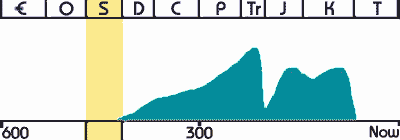
The following graphs show the abundance of the main fossil groups. The Silurian time period is highlighted in yellow.
The periods along the axis are the international geological systems in time order : Cambrian, Ordovician, Silurian, Devonian, Carboniferous, Permian, Triassic, Jurassic, Cretaceous (K) and Tertiary. The timeline at the bottom shows the approximate age in millions of years. On this scale one screen pixel represents 1.5 million years, so Homo Sapiens barely registers as the rightmost pixel of each graph.
Mollusca : Bivalves
Class : Bivalvia (Pelecypods, Limpets, Mussels, Oysters)
Two hinged halves protect a soft bodied invertebrate. Although present in the Cambrian this group diversified in the Silurian but gradually reached a peak in the late Cretaceous.
Example fossil Bivalve : Pteronitella retroflexa
Mollusca : Cephalopods
Class : Cephalopoda (Octopus, Squid, Ammonites)
The most advanced organization of all the molluscs, many still have a shelly body. The Nautiloid group are famous through the discovery of the 'living fossil' Nautilus ➚
that is the last remaining example of a group that has declined steadily since the late Ordovician. Belemite fossils are the readily recognizable narrow cones that are often well preserved in rock.
The Ammonoids were very common in Triassic and Permian but are now extinct, they were greatly affected by the extinction events at the end of the Triassic and became extinct at the same time as the Dinosaurs at the K-T boundary.
Echinodermata : Sea urchins
Class : Echinoidea (Sea urchins, Starfish)
The familiar round sea urchin shape with its tiny holes for tube feet are often spiny with distinctive five-fold symmetry.
Often poorly preserved as the 'test' or thin shell quickly breaks up into tiny fragments
Range from the Upper Ordovician to the present day but suffered a mass extinction at end of Permian.
Example fossil Brittle Star : Lapworthia miltoni
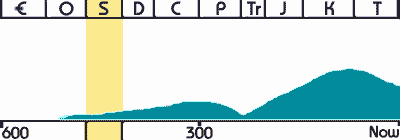
Brachipoda
Shells have two hinged segments but the two 'halves are not identical. Live by burrowing in mud or attached by a pedicle to rocks.
Some large groups notably the Pentamerids, Strophomenids and Spiriferids reached their climax in Silurian.
Range from the Cambrian to the present day but have declined steadily since the Palaeozoic.
Example fossil Brachiopod : Chonetes striatellus
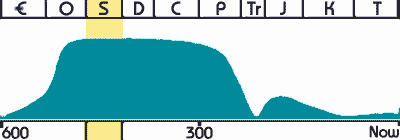
Colelenterata
Class Anthozoa (Corals)
Older Rugosa type range from the Ordovician to the Permian peak in the Carboniferous.
Tabulate corals dominant in the Silurian but became extinct by end of the Permian.
Modern corals replaced them in the Triassic.
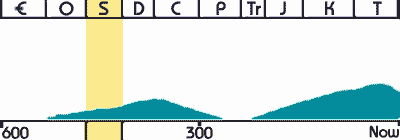
Arthropoda : Segmented animals
Class Arachnids (Scorpions and Spiders) : Insects, Spiders, Crabs, Centipedes, Trilobites
Evolve from aquatic forms to move to land during the land. Water scorpions reached sizes of 5ft in the Silurian.
Class Hexapoda (Insects)
A vast and varied group but poorly preserved. Range from Ordovician to the present day.
Class Trilobita
Shallow water marine creatures. Numerous in early Cambrian rocks, decline during Silurian, extinct by the Permian. The following graph shows the distribution of trilobites.
Example fossil Trilobite : Calymene blumenbachi
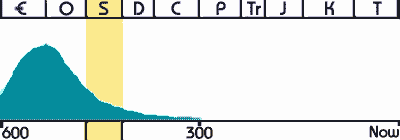
Hemi-Chordata
Class Graptolithina (Graptolites)
Graptolites were an extremely significant group of animals flourishing in the Palaeozoic
until declining in the Devonian and Carboniferous and became increasingly restricted to tropical seas.
A colony of zooids living in the 'bumps' (theca) along the spiral filtered tiny food particles in the sea.
Often preserved as conspicuous white elongated marks in slates and shales hence the name - from the Greek for
'stone' and 'write'.
Graptolites in the Lower Palaeozoic are extremely useful in correlating rocks of the same age as the individual species were relatively short lived but found over a wide area.
Example fossil Graptolite : Cyrtograptus murchisoni
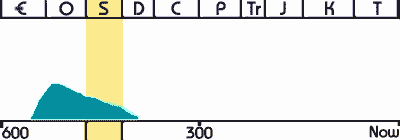
Chordata : Mainly vertebrate animals
Animals with central spinal nerve cord. Some soft forms do not actually have bones. As the Silurian coincides with the early stages of evolution of vertebrates, it is within the Silurian that their ancestry is being closely studied.
Vertebrates (Fish, Reptiles, Dinosaurs, Mammals, Birds)
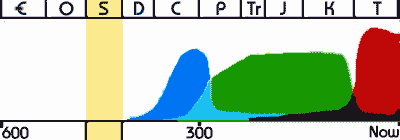
Fish appear in Silurian-Ordovician, Amphibians started in Devonian and common by the Carboniferous.
Dinosaurs start in Triassic until famously dying out at the end of the Cretaceous.
Mammals start in Triassic with low numbers until after Cretaceous.
The graph shows the relative abundance of Amphibians (blue) succeeded by Reptiles (green, including Dinosaurs) and finally by Mammals (red). Fish are not represented in the graph, they were present during Silurian period
but in a primitive form.